Chicken Road game original · read off its own screens · September 2026
Chicken Road game original: the InOut Games title, and the four things a copy gets wrong
There is one Chicken Road, and there are dozens of things called Chicken Road. The Chicken Road game original is an InOut Games title that runs inside a casino lobby, prices every lane on a printed card and pays out of a balance you can withdraw. Everything else — the store apps, the APK mirrors, the sites with a countdown and a promo code — is a copy of the artwork wrapped around something else. This page is about telling those apart, and about what the real game actually does once you are in front of it.
Open Vave Advertisement. Read the bonus terms and the verification clause before depositing.
Type the name into a search box and the results split in half. One half is a game inside a casino lobby. The other half is an app store, a download page, a video promising a pattern, a site with a promo code and a timer. Both halves use the same picture of the same chicken.
The Chicken Road game original is the first half: a title from the studio InOut Games, served by a casino's game server, priced in the balance the cashier pays out of. This page exists because the second half is bigger, louder and better at ranking, and because the difference between them is the difference between a bet and a purchase.

What “Chicken Road game original” actually means
The phrase is doing two jobs at once, and separating them makes everything else here simpler.
Job one: original as opposed to a clone. Somebody made this game. That somebody is InOut Games, and the titles carrying its name in a lobby's provider filter are the ones it signed. A good number of other studios have since built a chicken crossing a road, and those are separate games that happen to look alike — not versions of anything.
Job two: original as opposed to the sequel. There are two InOut titles. The first one, the Chicken Road game original in the narrow sense, and Chicken Road 2. Both are genuine; they differ in exactly one printed ceiling and in the row of quick bet chips, which is set out in full on Chicken Road 2.
Most people typing the phrase mean job one. They have seen an advert, found four apps with the same chicken, and want to know which one is the real Chicken Road game. That question has a four-step answer, and it takes about ninety seconds.
The Chicken Road game in one paragraph
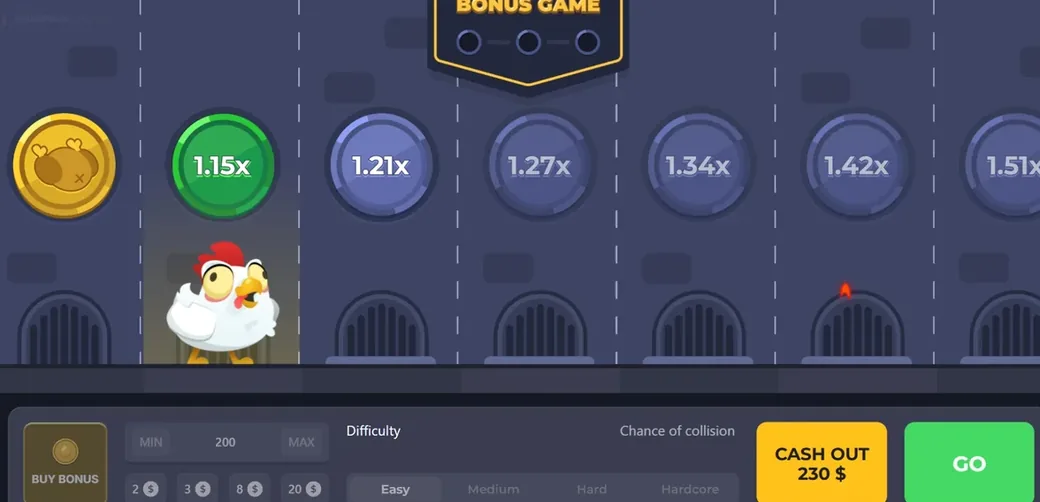
A chicken stands at the kerb. The road ahead is cut into lanes, and every lane has a multiplier printed on it, rising as they go. You set a stake, press once to step into the first lane, and the stake is now worth the multiplier under the chicken's feet. Press again and it steps to the next one, worth more. At any moment you can press cash out and take what the current lane says. Somewhere ahead, on a lane the game picked before you started moving, a car arrives, and if the chicken is still walking when it does, the stake is gone.
That is the whole thing. There is no hand to read, no symbol to match, no feature that changes the rules midway. It is one decision — step again, or stop — repeated until you stop or it stops you. The long version, lane by lane, is on how the Chicken Road game works.
Chicken Road real or fake: the four checks
Every real complaint about this game, every “I won and it vanished”, every “the app took my money”, traces back to one of these four going unchecked.
1. The provider filter says InOut Games
Casino lobbies group games by the studio that made them. Open the provider filter, find InOut Games, and what is listed under it is what that studio signed. If the chicken is not in that list, whatever you are looking at came from somewhere else — a clone by a different studio, or a page dressed up to look like a lobby.
This is the check that catches the most, because a clone can copy artwork freely and cannot put itself into a provider filter it is not in. Who the studio is and what else it signs is on InOut Games.
2. The round is priced in your casino balance
In the original, the stake box shows the same currency your balance shows, and a cash-out lands back in that balance a moment later. In a store app, the stake is in coins that were bought inside the app or handed out on a timer, and there is no route from those coins back to money. Some of those apps are honest about it in the small print. Most simply never mention it.
If you cannot reach the cashier from the same screen that holds the game, the balance is not money.
3. The information panel opens
The original prints its own rules. There is an “i”, or a menu behind the corner icon, and it opens onto the paytable, the rules of the round, the maximum win and the return figure for that build. That is the one place those numbers are authoritative, because the game prints them rather than a website repeating them. One return figure appears on this site and only one: the 98% the studio publishes on its own page for the game, quoted with the studio named on the studio page. Everything else about your build belongs to the panel in front of you, and copying a figure out of some other website is exactly how a wrong one spreads.
Open the panel. If there is no panel, there is no game.
4. The operator has a licence you can look up
The game settles into a balance, and the balance belongs to an operator. That operator either holds a licence with a number printed in a public register, or it does not. This is the part that decides whether a win becomes a withdrawal, and it has nothing to do with the chicken at all — it is covered in getting paid and in the list on where the original Chicken Road game runs.
The full side by side of original and copy, with what each one does when you press the same button, is on Chicken Road real or fake.
What the original Chicken Road game actually does
Once the four checks pass, the rest is mechanics, and the mechanics are worth knowing before the first stake rather than after.
The lanes are priced in advance. The multiplier on each lane is printed before you step, and it is the same sequence every round on that difficulty. What is not the same every round is where the car is. This matters more than it sounds: the ladder you see is information, and the risk is entirely in how far along it you choose to walk.
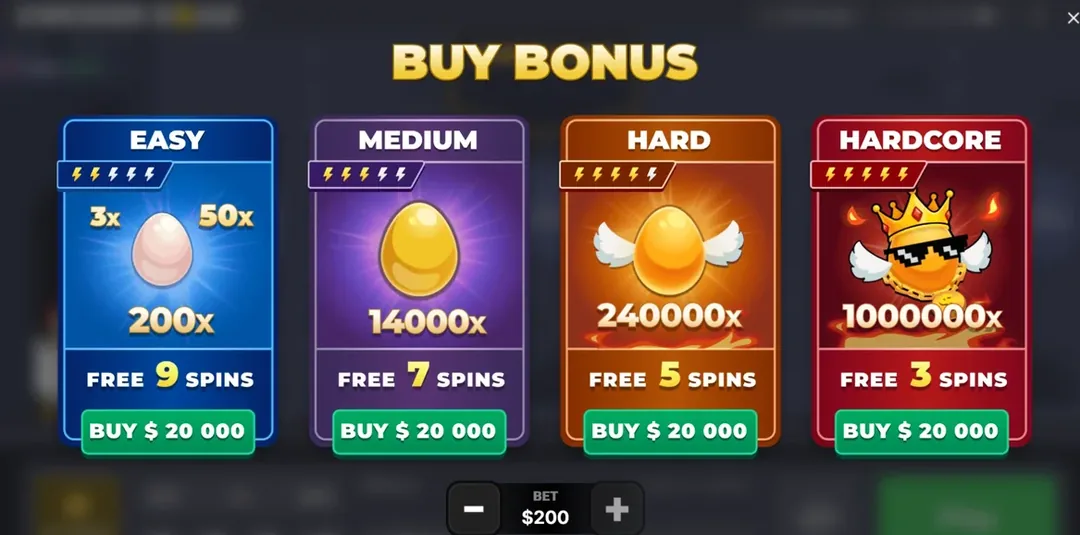
The card changes everything at once. Four difficulty modes, and moving between them does not just raise the ceiling — it changes how many lanes there are, how fast the multipliers climb, and how early the road tends to end.

The bonus is for sale, at a fixed price. One hundred times the stake currently set, on every card and in both titles. On a bet of 5 that is 500; on 10, 1,000; on 20, 2,000; on the maximum bet of 200, 20,000. It is the same purchase everywhere and the price does not move, which makes it unusually easy to judge — see buying the bonus.
The bet chips differ between the two titles. The sequel offers 1, 2, 5 and 10 under the bet box; the original offers 2, 3, 8 and 20. Both cap at 200 a round. Two games from one studio that feel different at the same balance, and the reason is a row of four buttons.
The four cards, and the ceilings printed on them
The difficulty card is the only dial on this game that matters, and it is worth reading properly because the numbers on it are specific rather than round.
In Chicken Road 2 the cards print x200 on Easy, x5,000 on Medium, x240,000 on Hard and x1,000,000 on Hardcore. The original Chicken Road game prints the same three outer figures and 14,000x on Medium — the only ceiling the sequel changed.
What moves together when you switch card:
- The lane count. A gentler card has a shorter road, fewer decisions per round, and a round that is over sooner.
- The climb rate. On Easy the printed multipliers rise slowly, so one more lane is worth little. On Hardcore they rise steeply, so refusing the next lane feels like leaving money behind.
- The ceiling. Four orders of magnitude between the gentlest card and the harshest.
What does not move is the house edge. A harder card is not a better deal and a gentler one is not safer in the sense people usually mean: what you are choosing between is variance, not value. Each card in turn is on difficulty modes, and what a printed maximum is actually worth — once the operator's own maximum payout clause is read on top of it — is on the ceiling.
Is there a Chicken Road game original download or APK?
No, and the reason settles a lot of other questions at once.
InOut Games distributes through casino operators. The game is a browser title: the operator's server runs the round and the phone draws it. There is nothing for the studio to package, which means there is no official file for any download to be a copy of — no signature to match, no checksum anybody published, nothing to compare a stranger's upload against.
That is why the files circulating under the name fall into three unhelpful groups: a shell app that just loads a website, a different game entirely installed under a famous name, and the “mod” and “unlocked” builds aimed squarely at people who have already decided to ignore a warning. And a modified client cannot change a result the server already recorded — it can only lie about it on your screen. The long version is on is there a Chicken Road APK.
On a phone the real procedure is shorter than any download: open the casino lobby in the browser, find InOut Games in the provider filter, open the title. Nothing installed, same build, same ladder, and the cashier is on the same screen.
Chicken Road demo: practising the one decision
The rhythm of this game is the part that costs people money — not the odds, the rhythm. It is a fast loop with a visible reward for one more press, and the first ten rounds are where a person decides how they are going to play the next hundred.
There are two free ways to meet it. A lobby demo runs the same build as the real game with a play balance, so the ladder, the cards and the prices are the ones you will meet with money. And the practice board on this site — ours, not the studio's, free, no account, no balance — reproduces the only thing here that can actually be practised: whether you take the lane you said you would take.
Use it this way. Pick a lane before you press anything, play ten rounds, and take the multiplier at that lane every time you reach it. Then count how many of the ten you actually did. That number is the most honest piece of information available about how you will play with money in it, and it costs nothing to find out. The free Chicken Road demo is one click away and takes no deposit in either direction.
Getting paid: how a win leaves the casino
Pressing cash out finishes the round and finishes the game's part in this entirely. There is no Chicken Road payment method and no Chicken Road payout time, because the game never touches money — it moves a number inside a casino balance.
Three things decide whether that number becomes money, and all three belong to the operator:
- The coins the cashier will send. A crypto cashier sends what it lists, and the network matters as much as the coin.
- The point where documents are demanded. Either a threshold named in the terms, which is a written commitment, or a risk-based reservation to ask at any time, which is honest and open-ended. Both are recorded, with the clause number, for every operator in the list below.
- The cap written into the withdrawal clause. Where one is published, it is in the table. Where none is, the table says “not published” — which is not the same as unlimited.
If a local rail such as UPI is what you actually need, that is a question for an operator's own cashier page before depositing, not a question about the game: the casinos listed here run crypto cashiers, so what goes in as coin comes out as coin. The whole subject, including what this desk refuses to claim about payout speeds, is on getting paid.
Chicken Road 2, in one line
Same studio, same one-button idea, one changed ceiling and a different row of chips. If the Medium card reads 14,000x you have the Chicken Road game original in front of you; if it reads x5,000 you have the sequel. Everything else about the two is on Chicken Road 2.
Why “original” became part of the name
Nobody searched for the Chicken Road game original when the game came out. They searched for Chicken Road. The word “original” arrived later, and it arrived for a reason worth knowing, because it explains why this page has to exist at all.
The title did well. Short advert clips of a chicken crossing a road went round, and the name picked up more search demand than the studio's whole catalogue behind it. That demand is free to point at anything: a store listing, a download page, a video channel, a prediction service. Within months there were more things called Chicken Road than there were Chicken Road games, and every one of them was competing for the same query.
So people started adding a word to the search to filter the noise out. “Original” is that word. It is a plea rather than a product name — it means the one the adverts were about, not the four knock-offs underneath it.
Which is why the honest answer to “where do I get the Chicken Road game original” is never a link to a file. It is a procedure: find the studio in a lobby's provider filter, open the title from there, and check that the balance you are staking is the balance a cashier can pay out. Everything else on this page is that procedure in more detail.
What a session on the Chicken Road game original costs
Three prices, all printed by the game, and all worth knowing before the first press rather than during the fifth.
The stake. Set before the round and fixed for it — there is no raising once the chicken is walking. The quick chips are what most people actually press instead of typing a number, and they differ between the titles: 1, 2, 5 and 10 in the sequel, 2, 3, 8 and 20 in the original. Both cap at 200 a round. That single row of buttons does more to shape how fast a balance moves than any difficulty card does.
The buy. One hundred times whatever stake is currently set. At the maximum bet that is a single press worth 20,000 — a hundred rounds of the largest stake the game accepts, committed in one action. Whether that is a reasonable way to spend a budget or a way to skip ninety-nine chances to stop is taken apart on buying the bonus.
The house edge, which is not printed as a price but is one. It is charged on every round, it does not improve on a harder card, and no system, pattern or purchase reduces it. The Chicken Road game original is engineered so that each individual press feels cheap; the sum of the presses is where the margin lives.
The defence is not a technique. It is two numbers chosen while nothing is at stake — the lane you will take, and the number of rounds you will play — and then kept. Our Chicken Road demo board exists to find out whether you actually keep them, and it costs nothing to be honest with yourself there first. If the game has stopped being a decision, the free and confidential helpline linked at the foot of every page on this site is worth reaching for earlier than it feels necessary.
Where the fakes come from, and why there are so many
A one-button game with a bright mascot is the easiest thing in a casino lobby to imitate. There is no complex paytable to reverse-engineer, no feature logic, no licensed sports feed. An artist copies the chicken, a developer wires up a road, and the result looks close enough in a screenshot to rank for the name.
They fall into three families, and each wants something different from you:
- Store apps. Free to install, coins instead of money, an advert between rounds. They want attention and ad revenue. They are not lying about being a game; they are quiet about the coins going nowhere.
- Downloaded files. Hosted anywhere, signed by nobody, “the version the casinos don't want you to have”. With no official build in existence, nobody vouched for what is inside.
- Predictor and hack sites. A signal, a pattern, a bot that tells you which lane the car is on. The round is settled on the operator's server before the chicken takes its first step, so there is nothing in the client to read ahead. What these sites sell is a subscription.
None of the three is a version of the original. All three are downstream of it.
Where the Chicken Road game original runs
The list below is the crypto casinos this desk reads terms for. They are ranked on what decides whether a win becomes money — the licence behind the balance, the coins the cashier takes, the point where documents are demanded and any cap written into the withdrawal clause — because the game itself is identical in every one of them. A lobby cannot make the chicken pay more.
One of them, marked as our partner, pays this site when a reader opens an account. That does not move it up the list and it does not change what is printed about it; the licence number, the coins and the verification clause are read the same way for every row. The full method is on how we check. Who writes this and how it is paid for is on about, and a figure on any page here that turns out to be wrong is worth more to us than the page is — send the correction.
A word about what the list cannot tell you: which titles a particular account sees depends on the operator and on the country the account was opened from. Catalogues are filtered, and a game that is in the lobby from one place is missing from another. The reliable check is still the provider filter, from your own account, on the day you look.