Chicken Road demo · free · no account
Chicken Road demo: a free board for the one decision this game is made of
The board below is ours, not the studio's. It is not the InOut Games title and does not pretend to be one: no money goes in, none comes out, and no account is involved. What it does reproduce is the only thing in Chicken Road that a person can actually practise — the moment where a printed multiplier is in hand and one more lane is on offer.
Most practice advice about gambling games is really advice about learning rules. Here there are barely any rules to learn — a stake, a step, a cash-out — and the demo spends its usefulness in about four rounds.
What is worth practising is narrower and much more awkward: whether you do the thing you said you were going to do.
1.00x
Press Step to send the chicken into the first lane.
Rounds played: 0 · reached your lane: 0 · ended early: 0
How to use it
Before you press anything, pick a lane. Say it out loud if that helps. Then play ten rounds and take the multiplier at that lane every time you reach it.
Then count how many of the ten you actually took it at.
That number is the only honest piece of information available about how you will play this game with money in it, and it is free. A person who takes their chosen lane nine times out of ten is playing a game. A person who takes it three times is being played by one, and no difficulty card, bankroll rule or stopping system fixes that — difficulty modes only decides how loudly the game argues.
What a lobby demo adds
The board here reproduces the decision. It does not reproduce the game, and there are things only the real build can show you:
- The actual ladder. The printed multipliers on each card, in order, as the studio set them.
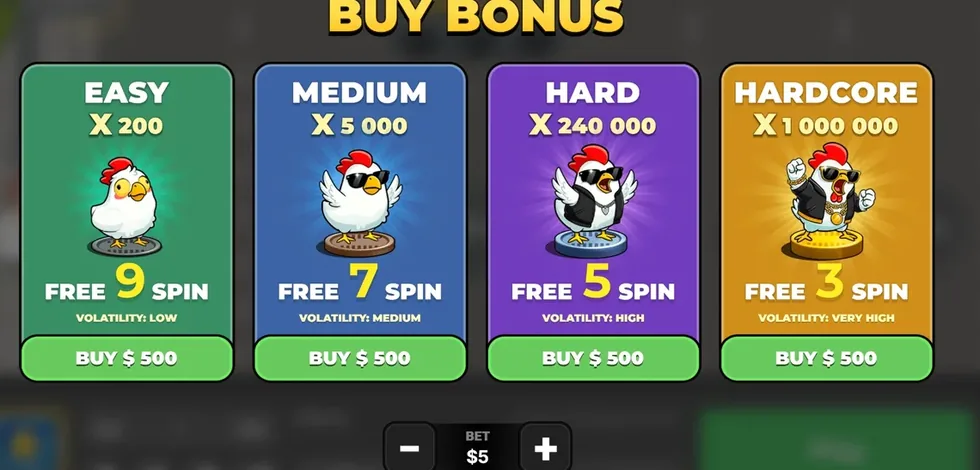
- The real prices. The bet chips — 1, 2, 5 and 10 in the sequel, 2, 3, 8 and 20 in the original — and the bonus buy at one hundred times the stake.
- The information panel. The paytable, the maximum win and the return figure for that build, printed by the game itself. The only return figure this site prints is the 98% the studio publishes on its own page for the game, and it is printed there with the studio named — see the studio. For your build, the panel in front of you outranks it.
Most lobbies open the title in demo without taking a deposit, and some without an account. The build in demo is the same build; only the balance is scenery.
The board here is ours. The game it is modelled on, and how to recognise it in a lobby, is on the Chicken Road game original.
Where a real Chicken Road demo actually lives
There are three places a search for a Chicken Road demo will send you, and only two of them open the studio's build.
A casino lobby. This is the one that counts. Open the lobby's provider filter, choose InOut Games, open the title, and look for the word demo, fun or practice on the tile or in the panel that appears before the first round. Most operators serve it without a deposit; some ask for an account first, and a few switch demo off entirely in certain countries. When it opens, the client running in front of you is the same client the money version runs — the lanes, the four difficulty cards, the bonus-buy price and the information panel are all the real ones. Only the balance is scenery.
The studio's own page. InOut Games publishes the title on its site with a playable window, and that window is the reference build, which makes it the cleanest place to read the paytable without a lobby's skin over it. It is also the place where the studio's name sits next to the game rather than being claimed by a third party, which is worth seeing once — see the studio.
Anything that asks you to install something. A Chicken Road demo does not come as a file. If a page offers a free version behind a download, an APK, a store listing or a sign-up before the game appears, what is being demonstrated is not this game — that whole family is taken apart on the download question.
What to read while the demo is open
A Chicken Road demo is worth more as a reading exercise than as a playing one, because everything the game will charge you later is printed on screen right now, for free, with nothing riding on it.
Open the information panel and note four things: the maximum win printed for this build, the return figure the panel states, the multiplier ladder for the difficulty card you have selected, and the price of the bonus buy. Then switch the card and watch all four move. That is the whole economy of the game, visible in about ninety seconds, and it is the part most people skip because the chicken is more interesting than the panel.
Two figures are worth writing down while you are there. The first lane price on each card tells you how fast the game pays at the start; the ceiling tells you what it is theoretically capable of and how unreachable that is. Both are on the difficulty cards and the ceiling, but reading them off the panel in a Chicken Road demo yourself is better than taking our word for either.
Chicken Road demo and Chicken Road 2 demo are different games
A lobby that carries one usually carries both, and the tiles look enough alike that people open the wrong one. The sequel is a separate title with its own lane prices, its own bet chips and its own bonus round, and a demo session on it teaches you nothing transferable about the first game's rhythm. If the demo you opened has different chips at the bottom of the screen — 1, 2, 5 and 10 rather than 2, 3, 8 and 20 — you are in the sequel. The two compared sets out what else changes.
What neither demo can give you
The feeling. A demo balance does not hurt to lose, so the decision it presents is not the decision you will face. Everybody stops at lane twelve when lane twelve is worth nothing.
That is not a reason to skip practice — it is a reason to be sceptical of what a good demo session proves. If ten disciplined rounds in demo are followed by three undisciplined ones with money, the demo was accurate and the conclusion was wrong.
Before the first real stake
Three things, in order:
- Decide the lane and the number of rounds. Both before anything is committed, both written down somewhere you will see them.
- Open the information panel on the build you are about to play, and read the maximum win and the return figure there rather than anywhere else.
- Check the way out before the way in. The money leaves through the operator's cashier, under the operator's verification and withdrawal clauses, and that is a separate subject from the game entirely — getting paid and the list on where it runs.
And if the board above is enough — if the decision is interesting and the money was never the point — that is a completely reasonable place to stop. Nothing on this site is an argument that you should be playing for money.
If you want to know what you would be playing instead, the original vs its copies is the page that matters most before a first deposit anywhere.