- Coins
- 6
- Withdrawal limit
- not published
- Before ID check
- case by case
- Operator
- Latcas B.V.
- Licence
- Curaçao Gaming Authority
Playing it · risk
The four cards, and what changes when you switch between them
Easy, Medium, Hard, Hardcore. Switching cards does not nudge the odds — it replaces the road. The number of lanes changes, the rate the printed multipliers climb changes, and the printed ceiling moves by four orders of magnitude between the gentlest card and the harshest. Here is what each one is for.
The four cards are the main dial on this game, and the only one that matters. Everything else — the stake, the chips, the speed you press — changes how much, not how.
- Coins
- not read
- Withdrawal limit
- 1,000,000 USDT /week cl. 6.10
- Before ID check
- 2,500 EUR
- Operator
- Moon Technologies B.V.
- Licence
- Curaçao Gaming Authority
- Coins
- 13
- Withdrawal limit
- 5,000 USD /month cl. 11.5
- Before ID check
- US$2,500
- Operator
- Danneskjold Ventures B.V.
- Licence
- Curacao
- Coins
- 10
- Withdrawal limit
- 15,000 EUR /month cl. 11.8
- Before ID check
- case by case
- Operator
- Metlait SRL
- Licence
- Anjouan Gaming Board
- Coins
- 10
- Withdrawal limit
- not published
- Before ID check
- case by case
- Operator
- Zentari Limitada
- Licence
- Anjouan Gaming Board
- Coins
- 8
- Withdrawal limit
- not published
- Before ID check
- case by case
- Operator
- Metaspins N.V.
- Licence
- Curaçao Gaming Authority
- Coins
- 9
- Withdrawal limit
- not published
- Before ID check
- case by case
- Operator
- RBGAMING N.V.
- Licence
- Anjouan Gaming Board
What actually changes
Three things move together when you switch card, and they move in the same direction:
The lane count. A gentler card has a shorter road. There are fewer lanes to walk and fewer decisions in a round, which is also why a round on Easy is over faster.
The climb rate. On the gentle card the printed multipliers rise slowly, so the difference between stopping at lane four and lane five is small. On the harsh card they rise steeply, so the same one-lane decision is worth several times more, and refusing it feels like leaving money behind.
The ceiling. Printed on the card, and it is where the four modes separate most visibly. In the sequel: x200 on Easy, x5,000 on Medium, x240,000 on Hard and x1,000,000 on Hardcore. The original prints the same three outer figures and 14,000x on Medium — the only ceiling the sequel changed.
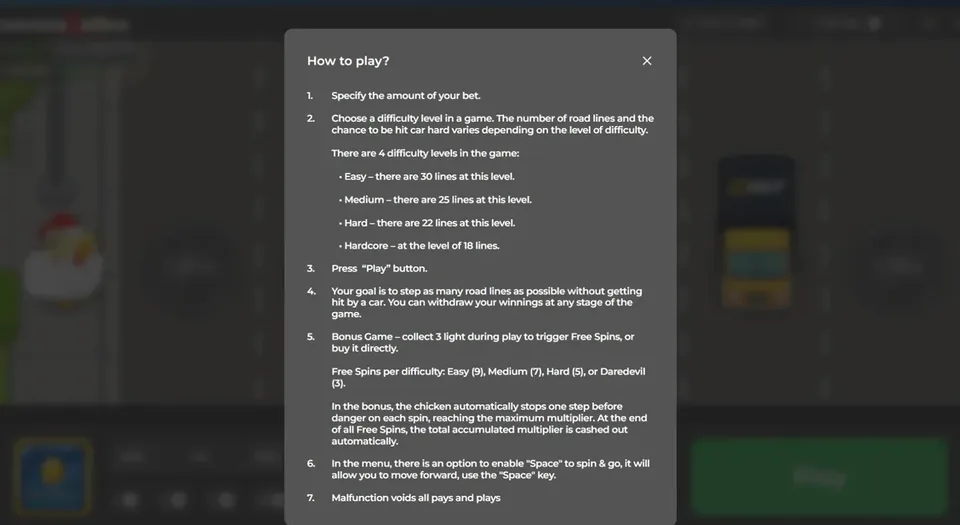
Easy
Short road, slow climb, low ceiling. Rounds resolve quickly and a large share of them end with something in hand rather than nothing.
What it is genuinely useful for is calibration: it is the card on which a person finds out whether they actually stop where they said they would, because on Easy the temptation to take one more lane is at its weakest and the answer is therefore honest. If you cannot keep a rule here, no card further along is going to be kinder about it.
Medium
The default in practice. The climb is fast enough that the ladder starts to feel like it is going somewhere, and short enough that a normal round still ends within a handful of lanes.
Medium is also the only card where the two titles differ at all on paper — 14,000x on the original's against x5,000 on the sequel's — which makes it the one place to look if you are curious which build you have open. Chicken Road 2 lays the two out side by side.
Hard
The ceiling jumps to x240,000 and the road gets long. Most rounds end early; the ladder is steep enough that the lanes you do reach are worth several times what the same lane number pays on Medium.
This is the card where the design bites hardest. Each press is worth more than the last by a wider margin, so the cost of stopping — in terms of what you can see on the next lane — is at its most vivid exactly when the chance of reaching it is falling. Nothing about that is a trick; it is arithmetic, and it is printed in front of you.
Hardcore
x1,000,000 on the card. In practice almost every round ends within the first few lanes, and the reason to be here is the shape of the outcome rather than its expected value: a long stretch of nothing, punctuated very occasionally by something that does not look like it belongs to the same session.
Two things worth saying plainly about the top card. First, the ceiling is not a promise — it is the largest number the game is willing to print, and the operator's own maximum payout clause sits on top of it and is usually the number that actually binds. The ceiling is about exactly this. Second, a card that pays rarely is a card that empties a balance quietly, because the rounds are cheap individually and there are a great many of them.
All four cards belong to the same title, and the title is the thing worth identifying first — see which Chicken Road game is the original.
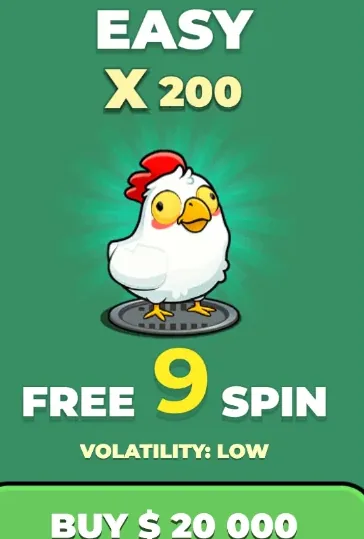
The thing that does not change
The house edge. A harder card is not a better deal and a gentler card is not a safer one in the sense people usually mean: over a session, all four take the same share. What you are choosing between is not value but variance — how the same expected loss is distributed across the evening.
That is not a reason to avoid the harder cards. It is a reason not to treat moving up one as a strategy. If the plan for recovering a bad hour is “switch to Hard”, the plan is to lose faster with better stories.
Picking one, honestly
- Want most rounds to end with something? Easy.
- Want the ladder to feel like it is climbing? Medium.
- Want the occasional round that is worth talking about, and are fine with most of them not being? Hard.
- Want a lottery ticket with an animation? Hardcore, and set the number of rounds before you start.
Whichever card, the decision that matters is still the one from how it works: the lane you chose before the round began. The card only decides how loudly the game argues with it.
The free demo board runs the same shape of decision with nothing attached, which is the cheapest place to find out which card you actually enjoy.