- Coins
- 6
- Withdrawal limit
- not published
- Before ID check
- case by case
- Operator
- Latcas B.V.
- Licence
- Curaçao Gaming Authority
The original · tells
Real or fake: what the original does that a copy cannot
A copy can take the chicken, the road, the colours and the font. What it cannot take is the plumbing behind them — the provider filter it is not listed in, the cashier it is not attached to, the register its operator is not in. Six tells, each one visible from the screen you are already on, and none of them requires trusting a review.
There are two questions hiding inside “is Chicken Road real or fake”, and they have different answers.
The first is whether the game is honest — whether the round is decided fairly. The second is whether the thing in front of you is the game at all. Almost everybody asks the first and needs the second, because the honest answer to the first is dull (the round is settled on the operator's server, and nothing you do changes it) while the second is where people actually lose.
- Coins
- not read
- Withdrawal limit
- 1,000,000 USDT /week cl. 6.10
- Before ID check
- 2,500 EUR
- Operator
- Moon Technologies B.V.
- Licence
- Curaçao Gaming Authority
- Coins
- 13
- Withdrawal limit
- 5,000 USD /month cl. 11.5
- Before ID check
- US$2,500
- Operator
- Danneskjold Ventures B.V.
- Licence
- Curacao
- Coins
- 10
- Withdrawal limit
- 15,000 EUR /month cl. 11.8
- Before ID check
- case by case
- Operator
- Metlait SRL
- Licence
- Anjouan Gaming Board
- Coins
- 10
- Withdrawal limit
- not published
- Before ID check
- case by case
- Operator
- Zentari Limitada
- Licence
- Anjouan Gaming Board
- Coins
- 8
- Withdrawal limit
- not published
- Before ID check
- case by case
- Operator
- Metaspins N.V.
- Licence
- Curaçao Gaming Authority
- Coins
- 9
- Withdrawal limit
- not published
- Before ID check
- case by case
- Operator
- RBGAMING N.V.
- Licence
- Anjouan Gaming Board
Tell 1 — the provider filter
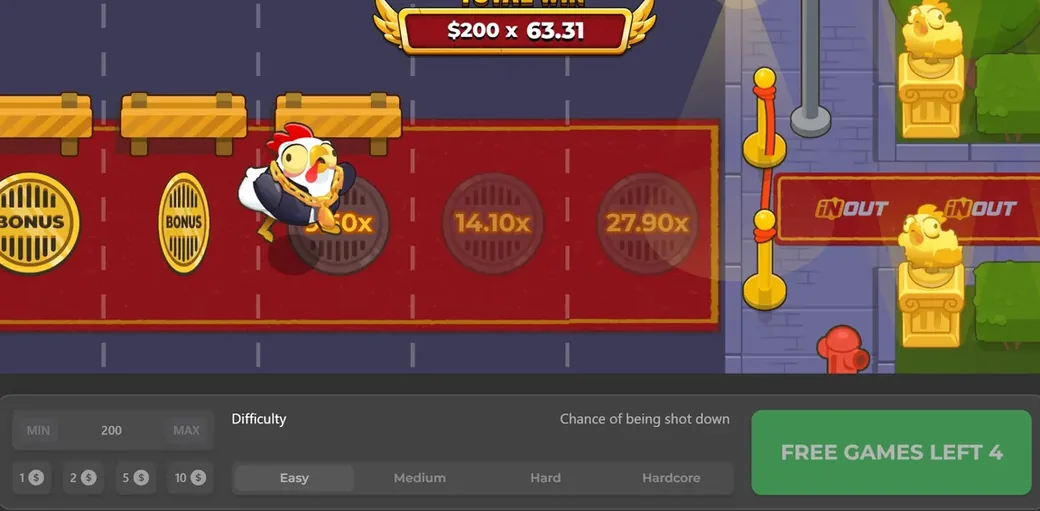
Every casino lobby has a filter that lists studios rather than games. Open it, find InOut Games, and the list under it is what that studio put its name on.
This is the strongest tell and the least known, because it works the wrong way round from how people search. Typing “chicken” into a lobby's search box returns everything in the catalogue with a chicken in the name, including clones by other studios that exist precisely because the name has become valuable. Filtering by provider returns only what one studio signed.
Tell 2 — where the stake comes from
Look at the number next to the stake box and the number in the top corner of the screen. In the original they are the same currency, and pressing cash out moves value from one to the other in front of you.
In a store app the stake is in coins. Coins arrive on a timer, arrive from watching an advert, or are bought with money. None of those three routes runs backwards. Whether the screen calls them coins, chips, credits or cash, the question is the same: is there a cashier on this screen, and does it have a withdraw button.
Tell 3 — the information panel
The original prints its own rules. There is an “i”, or a menu behind the corner icon, and it opens onto the paytable, the rules of the round, the maximum win and the return figure for that build.
Copies usually skip this entirely, because writing a paytable means committing to numbers. Where a copy does carry a panel, the numbers inside it tend to be round, generous and unattributed.
One caution that applies to the original too: the figures in that panel describe the build you have open, and builds differ between operators and between the two titles. Read them in front of you. This site does not reprint a return percentage from somewhere else, and neither should any page you are reading.
Tell 4 — the ceiling on the card
The difficulty cards carry printed maximums, and they are specific rather than round. The sequel reads x200 on Easy, x5,000 on Medium, x240,000 on Hard and x1,000,000 on Hardcore. The original reads 14,000x on its Medium card.
A number like 240,000 is hard to invent by accident, which makes the set of them a fingerprint. A copy advertising “up to x100,000” or “win 5000x” in a store description is describing something else. More on what those ceilings are worth in practice on the ceiling.
Tell 5 — the bonus price
The bonus buy in the original costs one hundred times the stake currently set, and that ratio does not change with the difficulty card. Set the bet to 5 and the price reads 500. Set it to 10 and it reads 1,000. Set it to 20 and it reads 2,000. At the maximum bet of 200 it reads 20,000.
A fixed multiple, not a menu of tiers, and it is the same in every lobby. Buying the bonus takes it apart.
All six tells, together with the mechanics they protect, are collected on the page about the Chicken Road game original.
Tell 6 — the licence behind the balance
The last one is not about the game. The chicken can be perfectly genuine and the money can still be stuck, because the money never belonged to the game. It belongs to the operator whose balance the round settles into.
That operator either holds a licence with a number printed in a register anybody can open, or it does not. Where the number is real, it is worth exactly what the register says and nothing more — a licence is not a guarantee of payment, it is a route to complain. But an operator with no number at all leaves you with no route at all. The list on where it runs prints the number for each one; getting paid covers what happens after you press withdraw.
The three families of fake, and what each one is after
Store apps are the largest family by far and the least dangerous. They are real software, they run, they are usually free, and they earn from advertising. The problem is one of category: the coins are scenery. If somebody plays one of these for a month and then opens a real lobby expecting the same thing, the difference is not a feature — it is that this time the stake is money.
Downloaded files are the family worth avoiding outright. There is no official Chicken Road APK from InOut Games, so every file with that name was assembled by somebody else, and the ones advertised as “unlocked”, “mod” or “with the pattern built in” are advertising the thing that should make you close the tab. The full reasoning is on is there an APK.
Prediction services sell a subscription for information that cannot exist. The outcome of a round is fixed on the operator's server before the chicken takes its first step, so there is nothing inside the page or the app to read ahead. The demonstrations on those sites are recordings, and a recording of a win proves nothing about the next round.
What the original does not do either
For fairness: the real game is not a better deal because it is real. It keeps a house edge on every round, it is engineered to make one more press feel cheap, and no amount of authenticity changes either fact. The point of this page is narrower — that if you are going to bet, you should at least be betting into the thing you think you are betting into.
If you want the rhythm without the money attached, the Chicken Road demo here runs the same shape of decision for nothing. And if you want the mechanics before the first stake, start at how it works.