- Coins
- 6
- Withdrawal limit
- not published
- Before ID check
- case by case
- Operator
- Latcas B.V.
- Licence
- Curaçao Gaming Authority
The sequel · comparison
Chicken Road 2 against the original, card by card
Two titles, one studio, one idea. What separates them is not the artwork but the numbers printed on the cards: different ceilings, different bet chips, a different feel at the same balance. If you are trying to work out which of the two is open in front of you, the cards answer it in about five seconds.
When a one-button game gets a sequel, there is not much room to add anything. You cannot deepen a mechanic that consists of “press, or stop”. So what InOut Games changed instead was the arithmetic, and that turns out to be enough to make the two feel different.
- Coins
- not read
- Withdrawal limit
- 1,000,000 USDT /week cl. 6.10
- Before ID check
- 2,500 EUR
- Operator
- Moon Technologies B.V.
- Licence
- Curaçao Gaming Authority
- Coins
- 13
- Withdrawal limit
- 5,000 USD /month cl. 11.5
- Before ID check
- US$2,500
- Operator
- Danneskjold Ventures B.V.
- Licence
- Curacao
- Coins
- 10
- Withdrawal limit
- 15,000 EUR /month cl. 11.8
- Before ID check
- case by case
- Operator
- Metlait SRL
- Licence
- Anjouan Gaming Board
- Coins
- 10
- Withdrawal limit
- not published
- Before ID check
- case by case
- Operator
- Zentari Limitada
- Licence
- Anjouan Gaming Board
- Coins
- 8
- Withdrawal limit
- not published
- Before ID check
- case by case
- Operator
- Metaspins N.V.
- Licence
- Curaçao Gaming Authority
- Coins
- 9
- Withdrawal limit
- not published
- Before ID check
- case by case
- Operator
- RBGAMING N.V.
- Licence
- Anjouan Gaming Board
The cards, side by side
The printed ceilings are the clearest separation.
| The original | Chicken Road 2 | |
|---|---|---|
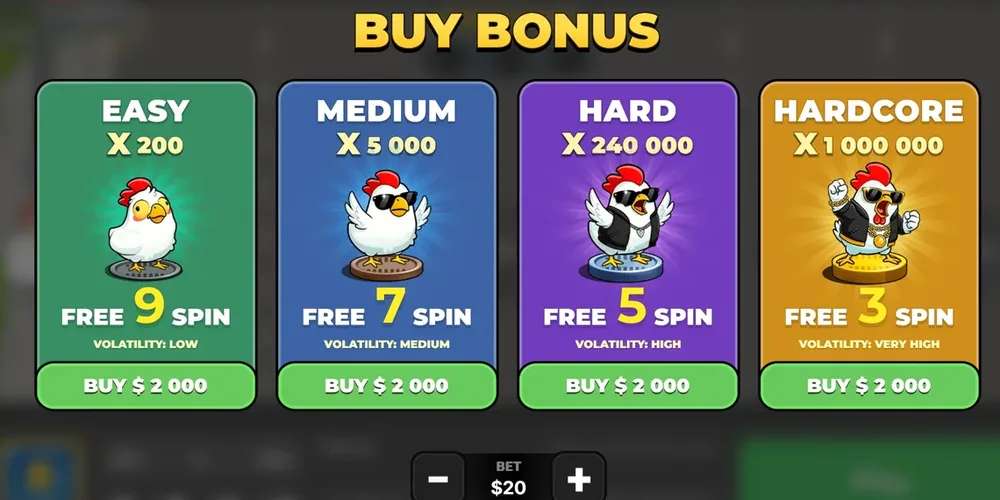
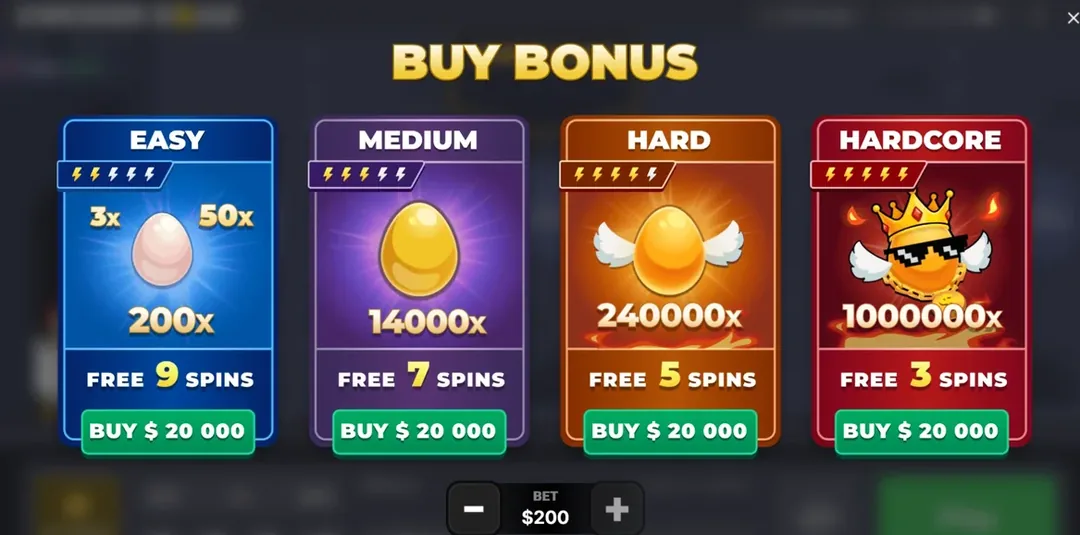
| Easy | 200x | x200 |
| Medium | 14,000x | x5,000 |
| Hard | 240,000x | x240,000 |
| Hardcore | 1,000,000x | x1,000,000 |
| Bet chips | 2, 3, 8, 20 | 1, 2, 5, 10 |
| Maximum bet | 200 a round | 200 a round |
| Bonus buy | 100× stake | 100× stake |
| Volatility shown as | lightning bolts | words |
Two things stand out, and the first one is how little moved.
Only Medium was re-priced. Three of the four ceilings are identical between the two games — 200, 240,000 and 1,000,000 — and the sequel cut Medium from 14,000x to x5,000. That is the whole change to the ladder, and it is the fastest way to tell which title is open: read the Medium card, and the number tells you which game you are in.
The spread is enormous either way. Four cards running from x200 to x1,000,000 is four orders of magnitude, so the choice of card is a far bigger decision than the choice of title. What each one is actually for is on difficulty modes.
The chips matter more than they look
1, 2, 5 and 10 against 2, 3, 8 and 20.
Nobody chooses a game on its quick-bet buttons, and yet those buttons are what most people actually press instead of typing a stake. The original's lowest chip is the sequel's second one, and its top chip is twice the sequel's. On the same balance, the original therefore spends faster by default — not because it is more expensive, but because the cheapest available press is bigger.
If you are moving between the two and a session feels shorter than it used to, this is usually why.
What did not change
The idea. A chicken, a road cut into priced lanes, a step button and a cash-out button. Everything on how it works applies to both titles without amendment.
The settlement. Both are decided on the operator's game server before the chicken moves. Both are therefore immune to anything pressed, timed or installed — which is the reasoning on is there an APK.
The bonus price. One hundred times the stake currently set, in both titles, on every card. 500 on a bet of 5, 1,000 on a bet of 10, 2,000 on a bet of 20, 20,000 at the maximum bet of 200. Buying the bonus covers what the purchase actually gets you.
The house edge. A larger printed ceiling is not a better deal. It is a wider distribution of the same expected outcome, which is the point made at more length on the ceiling.
How long each road actually is
The ceilings get quoted everywhere and the road lengths almost never do, which is backwards: the length is what makes the ceiling possible.
The game's own How to play panel lists them. Easy is a thirty-line road. Medium is twenty-five. Hard is twenty-two. Hardcore is eighteen. That is the entire mechanism behind the four cards — a harder card is not a road with worse luck on it, it is a shorter road with a higher price per lane and a higher chance of a car on each one.
Run the arithmetic in the other direction and the top card stops looking mysterious. Eighteen lanes, each one paying a little over two-thirds more than the last, compound to seven figures by the end. Reaching lane eighteen on Hardcore is the same event as reaching the printed ceiling; there is nothing else in the game that pays a million. The road is short precisely so that the number at the end can be large and still almost never happen.
This is also why the two titles feel different at the same difficulty setting despite sharing three of four ceilings. Chicken Road 2 prices its lanes to arrive at x5,000 over twenty-five lanes on Medium; the original prices the same twenty-five lanes to arrive at 14,000x. Every individual step on the original's Medium card is therefore worth slightly more — and the round ends slightly sooner, on average, to pay for it.
The bonus round, and where the sequel spends its differences
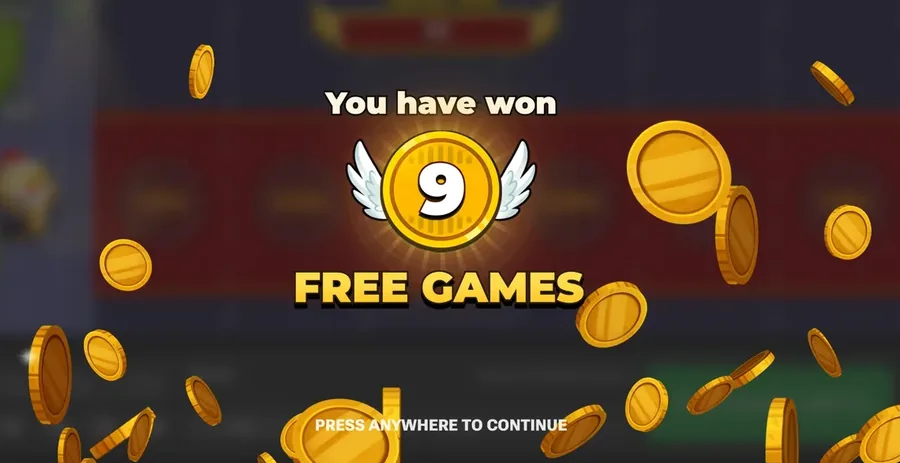
Both titles carry a free-spin feature and both open it the same two ways: collect three lights or eggs during ordinary play, or buy it outright for a hundred stakes. What the feature does once it is open is the part worth photographing.
The free-spin count is set by the card, not by how you got in: nine spins on Easy, seven on Medium, five on Hard, three on Hardcore. The studio's own panel calls the top tier Daredevil there while the card on screen says Hardcore — one of several places where the game's text has not entirely caught up with itself.
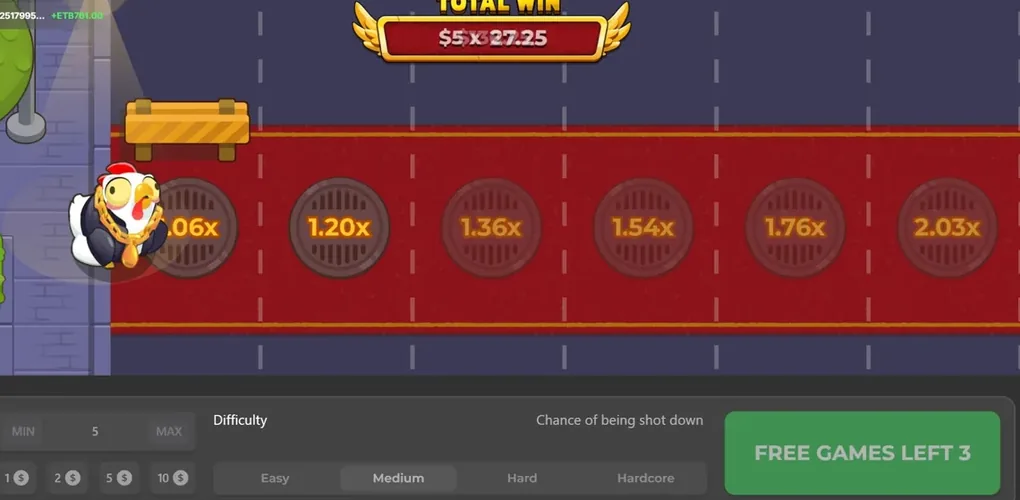
Inside the feature the chicken walks by itself. It steps forward and stops one lane short of danger on each spin, and the multiplier does not reset between spins the way it does between paid rounds: it accumulates across the whole feature and is cashed out once at the end. That is why a bonus road can open at 1.01x, 1.02x, 1.05x — prices that would be insulting in a paid round — and still finish somewhere serious. The flat opening is not the game being stingy; it is the game starting a running total that has nine spins to grow.
The bonus road also carries its own coins. Landing one extends the feature rather than paying directly, so a run that keeps finding them can stretch well past its printed spin count. Four of them in a row, late in a feature that started on Easy, is how a total climbs into five figures on a modest stake.
Three practical consequences, none of them about strategy:
- A bought bonus on Easy is nine spins with an x200 roof. It costs the same hundred stakes as three spins with a million-times roof on Hardcore. The card decides what you bought; the price never moves.
- The bonus is the only part of either game that plays itself. If a build lets you step manually inside the free-spin round, it is not running the studio's feature.
- Collecting is free and buying is not. The feature that arrives after three lights is identical to the one that arrives after a purchase, which makes the purchase a question about patience rather than about access.
Which one a lobby shows you
Most operators carrying InOut Games carry both, and many put the sequel forward because it is the newer release. That is a merchandising decision rather than a statement about the games.
What is not up to the operator's shelf is which titles your account can see: catalogues are filtered by the operator and by the country an account was opened from, so a title present for one player is missing for another. The provider filter, from your own account, on the day you look, is the only check that answers this — as explained on original vs copies.
Both titles are genuine InOut releases; telling either of them from a clone is a separate check, set out on the Chicken Road game original.
Picking between them
- Want the widest spread of outcomes and the biggest printed number? The sequel, and specifically its top two cards.
- Want the ladder the original's Medium card prints, at 14,000x? The original — that number does not exist in the sequel.
- Playing a small balance and want the smallest available press? The sequel, because its bottom chip is half the original's.
- Want the decision without money attached? Neither: the Chicken Road demo.
Whichever one is open, the numbers above should be confirmed in the game's own information panel before they matter to a stake. Builds differ between operators, and the panel in front of you outranks any page — including this one. More on that standard on how we check.