The original · the studio
InOut Games, and why the studio name is the check that works
The single most useful fact about this game is the name of the company that made it, because that name is the one thing a copy cannot borrow where it counts. Artwork is easy to lift. A place in a lobby's provider filter is not.
Casino games have two companies behind them and people usually notice only one.
The operator is the casino: it holds the licence, keeps your balance, takes the deposit and pays the withdrawal. The studio builds the game and licenses it to operators. When something goes wrong with a payout, it is the operator's problem; when something is wrong with a paytable, it is the studio's.
Chicken Road and Chicken Road 2 are InOut Games titles. That is the fact this whole site turns on.
Why the studio name is the tell
Everything visible about a casino game can be copied. The chicken, the road, the colour of the lanes, the shape of the cash-out button, the font on the multiplier — all of it is pixels, and pixels are free.
What cannot be copied is a listing in a lobby's provider filter. That filter is not decorative: it reflects the contracts an operator actually has with studios, and a title appears under a studio's name because the operator integrated that studio's games. A clone can be in the catalogue — plenty are — but it appears under whoever made it, not under InOut Games.
So the check is:
- Open the lobby's provider or studio filter.
- Find InOut Games.
- The titles under it are the studio's.
Search boxes do the opposite of this. Type “chicken” and you get every title in the catalogue with a chicken in its name, which by now includes a good number of games that exist because the name became valuable. That is the confusion being monetised, and it is covered in full on original vs copies.
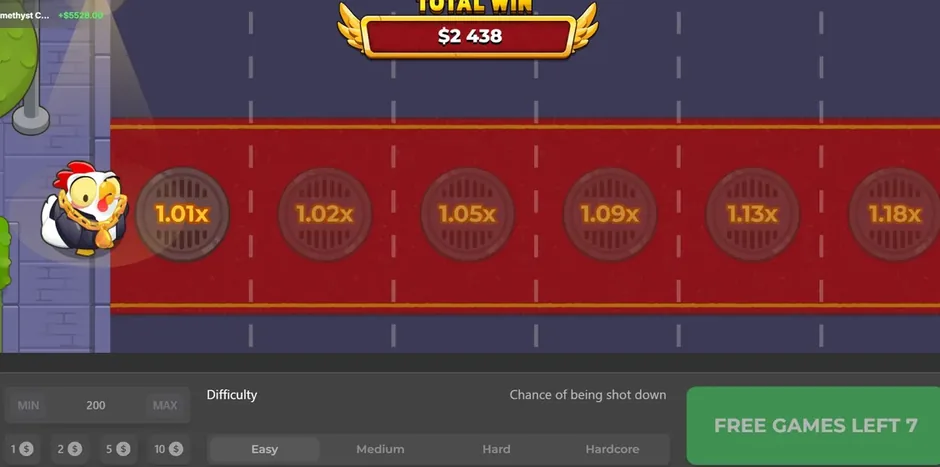
What the studio publishes about the game itself
InOut Games keeps a page for Chicken Road on its own site, and three fields on it are worth copying down, because they are the studio's own statement rather than an affiliate's summary.
| Field, as the studio prints it | Value |
|---|---|
| Players | Single Player |
| RTP | 98% |
| Release Day | 04.04.2024 |
The date settles an argument. Chicken Road was released on 4 April 2024. Anything presenting itself as an older, original or classic version of this game predates the game, which is not a thing that can happen. The store listings with review histories going back further are different products that acquired the name later.
The return figure has a source now. The studio prints 98% on that page, and this is the only place on this site where that number appears with our name attached to it. Two cautions come with it. A theoretical return is a long-run average over a volume of rounds no individual player will produce, so it describes the game, not your session. And operators sometimes run a build configured differently from the studio's default — which is why every page here keeps telling you to open the information panel in the client in front of you and read the figure it prints. If the panel disagrees with the studio's page, the panel is what your money is playing against.
Single player is not a small detail on a game whose copies frequently advertise tournaments, leaderboards and head-to-head modes. There is no opponent in Chicken Road. A build that gives you one has added something the studio did not.
The studio's page also carries a demo of the title, which makes it the cleanest place to read a paytable without a lobby's promotions around it — the demo covers what to do with it.
The rest of the catalogue
Chicken Road is not the studio's only release and looking at the others tells you what kind of shop it is. The catalogue on its site runs to titles like Tower Dash, Dragon Pots, Wheel Out, Frog Jump, Royal Drop, Joker's Clash, KO Million, Rump And Friends and MegaBlock Empire — a mix of the same single-decision format as Chicken Road and ordinary reel games, with new releases arriving regularly.
Two things follow from that list. The first is that this is a working studio with a production line rather than a single viral hit, which is the ordinary shape of a supplier an operator signs a contract with. The second is more useful at the moment you are standing in a lobby: if the provider filter shows InOut Games and the titles underneath it are these, you are looking at the real integration. A catalogue listing exactly one InOut game, and that game a chicken, is worth a second look.
The studio's site also publishes a restricted-countries list and a KYC policy of its own, and takes business enquiries at a partners address. None of that is a consumer support channel — the studio does not hold your balance and cannot move it, which is set out again below.
What the studio does not do
It does not run a casino. There is no InOut Games lobby to play at, no balance held by the studio, no cashier. If a site presents itself as the studio's own casino, it is not.
It does not publish an app. Its titles are served in the browser from the operator's game server, so there is nothing for it to package and distribute. This is why every file circulating as a Chicken Road APK was made by somebody else — the reasoning is on is there an APK.
It does not pay your withdrawal. The money is with the operator, under the operator's terms, and that is where verification, caps and coins live: getting paid.
What the studio does decide
The parts of the experience that are the same everywhere:
- The ladder. The printed multiplier on each lane, in order, per difficulty card.
- The cards. Four of them in the sequel, with ceilings printed at x200, x5,000, x240,000 and x1,000,000; 14,000x on the original's Medium card. Taken apart on difficulty modes.
- The bet chips. 1, 2, 5 and 10 in the sequel, to a maximum of 200 a round; 2, 3, 8 and 20 in the original.
- The bonus price. One hundred times the stake currently set, on every card — see buying the bonus.
- The information panel, where the paytable, the maximum win and the return figure for that build are printed. That panel is the authority on those numbers for your build, and the studio’s own 98% above is the only return figure this site carries from anywhere else.
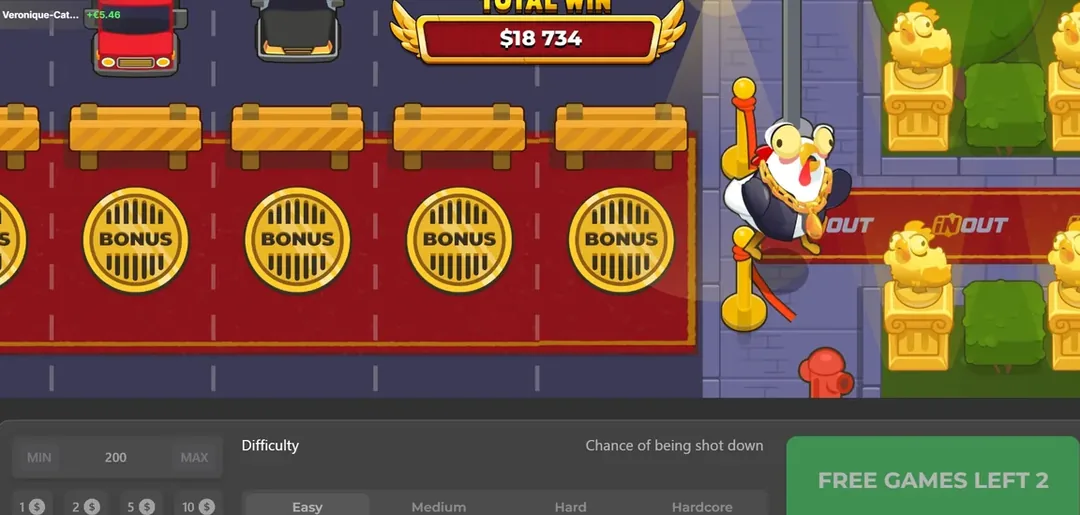
Two titles, one idea
The studio's approach to a sequel was not to add mechanics but to change arithmetic: different ceilings, different chips, a different feel at the same balance, with the one-button decision untouched. The comparison is on Chicken Road 2.
That restraint is also why the game is copied so much. There is nothing complicated to reproduce — which makes it cheap to imitate badly, and makes the studio's name the only thing worth checking.
The studio name is the first of four checks; the other three, and what the game does once they pass, are on the Chicken Road game original.
Trademarks, and what this site is not
Chicken Road and Chicken Road 2 are the studio's games and the studio's marks. This site is not InOut Games, has no connection to it, and speaks for nobody but itself. Every number here was read off the game's own screens or off what an operator published, with the standard set out on how we check.
Where the titles run, with the licence behind each balance, is on where it runs.