- Coins
- 6
- Withdrawal limit
- not published
- Before ID check
- case by case
- Operator
- Latcas B.V.
- Licence
- Curaçao Gaming Authority
Playing it · rules
How the game works: one button, thirty lanes and a price on each
Chicken Road has fewer rules than almost anything else in a casino lobby, which is why it is worth reading them properly: there is nothing to learn later, and nothing to blame afterwards. A stake, a row of priced lanes, a step button, a cash-out button, and a car somewhere ahead on a lane that was chosen before you moved.
A round has four moving parts and one of them is you.
- Coins
- not read
- Withdrawal limit
- 1,000,000 USDT /week cl. 6.10
- Before ID check
- 2,500 EUR
- Operator
- Moon Technologies B.V.
- Licence
- Curaçao Gaming Authority
- Coins
- 13
- Withdrawal limit
- 5,000 USD /month cl. 11.5
- Before ID check
- US$2,500
- Operator
- Danneskjold Ventures B.V.
- Licence
- Curacao
- Coins
- 10
- Withdrawal limit
- 15,000 EUR /month cl. 11.8
- Before ID check
- case by case
- Operator
- Metlait SRL
- Licence
- Anjouan Gaming Board
- Coins
- 10
- Withdrawal limit
- not published
- Before ID check
- case by case
- Operator
- Zentari Limitada
- Licence
- Anjouan Gaming Board
- Coins
- 8
- Withdrawal limit
- not published
- Before ID check
- case by case
- Operator
- Metaspins N.V.
- Licence
- Curaçao Gaming Authority
- Coins
- 9
- Withdrawal limit
- not published
- Before ID check
- case by case
- Operator
- RBGAMING N.V.
- Licence
- Anjouan Gaming Board
1. The stake
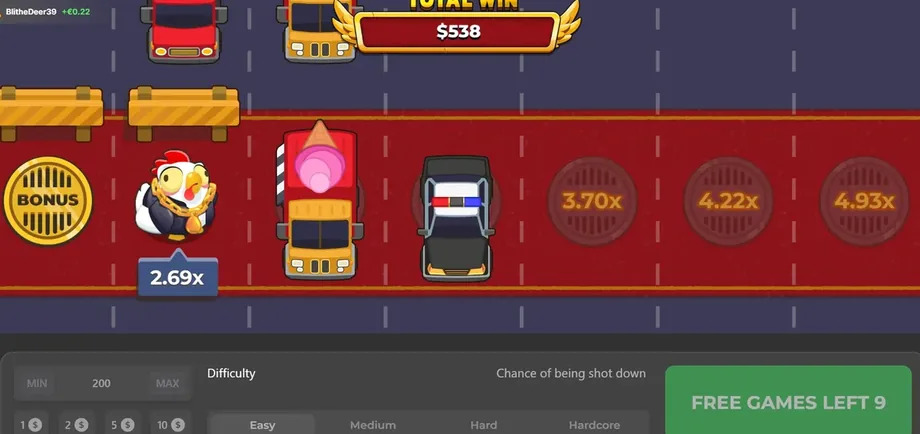
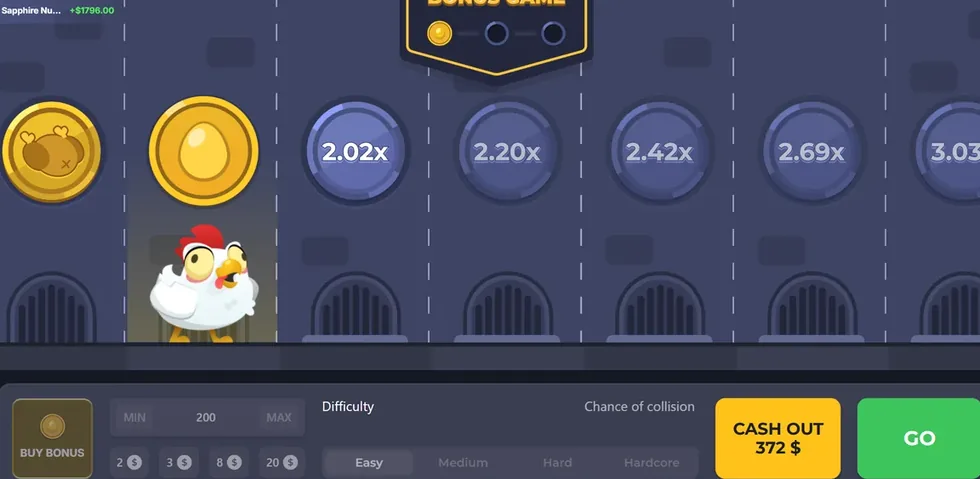
Set before anything else, and fixed for the whole round — there is no raising or hedging once the chicken is walking. The quick chips under the box differ between the two titles: 1, 2, 5 and 10 in the sequel, which tops out at 200 a round, and 2, 3, 8 and 20 in the original. That row of four buttons does more to shape a session than most people notice, because the chips are what a person actually presses instead of typing a number.
2. The card
The difficulty card decides the shape of the road: how many lanes there are, how steeply the printed multipliers climb, and how far along the road the car tends to be waiting. Four cards, and switching between them is not a fine adjustment — it is a different game with the same art. Difficulty modes takes each one in turn.
3. The lanes
Here is the part that makes this game unusual: the ladder is public. Every lane's multiplier is printed before you step onto it, and the sequence is the same every round on that card. You are never guessing what the next lane pays. You are only deciding whether to go and get it.
That is worth sitting with, because it inverts the usual casino experience. A slot hides its maths behind a reel; this game hands you the whole ladder up front and then asks, thirty times in a row, whether you would like to keep going. The information is free. The restraint is the expensive part.
4. The car
The one thing that is not printed. Where the road ends was decided on the operator's game server at the moment you committed the stake, before the chicken took a step. The animation is the delivery of a result that already exists, which has two consequences worth being precise about:
- Nothing you press changes where the car is. Stepping faster, stepping slower, tapping in a rhythm, switching hands — the result was fixed before any of it.
- Nothing from the last round carries into this one. A long run does not make a short one due, and five short rounds do not owe you a long one. Each round is drawn on its own.
Both of those are also why the prediction services described on original vs copies have nothing to sell.
The one decision, and why it is hard
Pressing step costs nothing visible. The multiplier goes up, the chicken is fine, and the gap between where you are and the next lane looks small. That is the whole design: every individual press is cheap, and the sum of them is the game's margin.
The defence is not a system. It is a number chosen before the round starts, and kept. A lane, or an amount, or a count of rounds — it does not much matter which, as long as it was decided while nothing was at stake. This sounds like advice from a poster, and it is, and it is also the only thing that separates a session that ends on purpose from one that ends when the balance does.
The board on the Chicken Road demo board exists for exactly this: to find out what your own stopping point feels like when there is nothing behind it.
These rules describe the InOut build and nothing else; which build you actually have open is settled by the four checks on the original Chicken Road game.
Cashing out
Press cash out and the multiplier under the chicken's feet is applied to your stake, and the amount is in your balance. That transaction is finished — it cannot be reversed by a later round, and it cannot be un-won.
What can still go wrong afterwards has nothing to do with the game: verification demands, withdrawal caps, coins the cashier will not send. That is a different subject with its own page, getting paid, and it is the part that turns a win into an amount you can actually spend.
The buy
There is a purchase button on the card: one hundred times the stake currently set, and the price is the same multiple on every difficulty. It is the only way to spend more than the stake in a round, and the only thing on the screen with a fixed, checkable price — see buying the bonus.
Reading the numbers off the game
Everything specific above — chips, bet ceiling, bonus price, card maximums — is printed by the game, not by this site's opinion of it. The place to confirm any of it is the information panel behind the corner icon, on the build you have open, because builds differ between operators. That is also where the return figure for your build is printed. The studio publishes 98% for the title on its own page, and that is the one figure this site repeats, with the source named; where an operator's panel says something else, the panel is what your money is playing against.
Next: what the studio behind the game actually is, on InOut Games, or what the second title changed, on Chicken Road 2.