- Coins
- 6
- Withdrawal limit
- not published
- Before ID check
- case by case
- Operator
- Latcas B.V.
- Licence
- Curaçao Gaming Authority
Playing it · the buy
The bonus buy: a fixed price, and the one thing on screen you can actually check
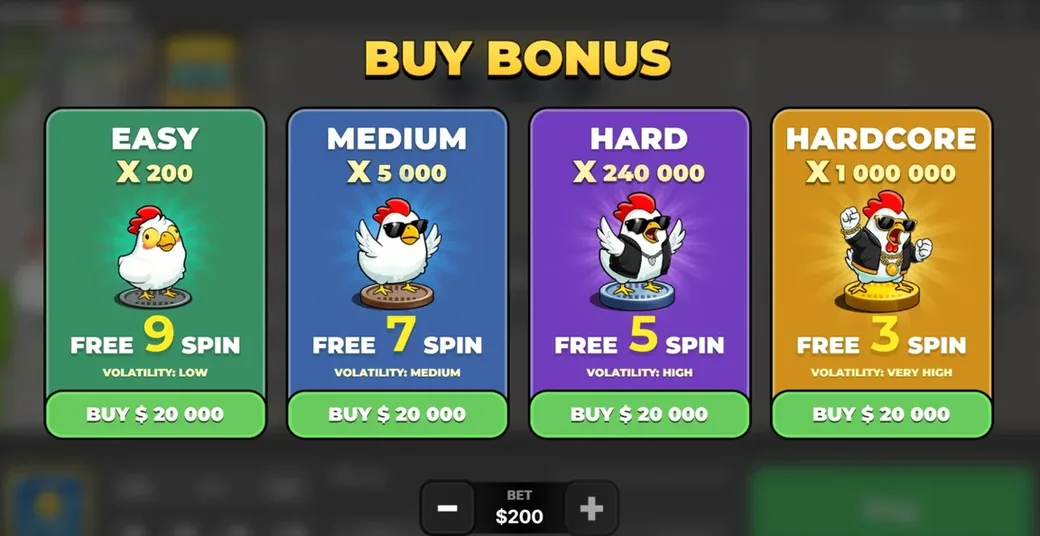
One hundred times the stake currently set, on every difficulty card, in both titles. It is the only price in this game that never moves, which makes it the easiest thing here to judge honestly — and the easiest thing to talk yourself into, because a fixed multiple looks small next to a ceiling with six digits.
Most things in a casino hide their price. This one prints it.
The bonus buy costs one hundred times the stake currently set, and that multiple does not change — not between the four difficulty cards, not between the original and the sequel, not between one operator's lobby and another's. Set the bet and the price follows it exactly.
- Coins
- not read
- Withdrawal limit
- 1,000,000 USDT /week cl. 6.10
- Before ID check
- 2,500 EUR
- Operator
- Moon Technologies B.V.
- Licence
- Curaçao Gaming Authority
- Coins
- 13
- Withdrawal limit
- 5,000 USD /month cl. 11.5
- Before ID check
- US$2,500
- Operator
- Danneskjold Ventures B.V.
- Licence
- Curacao
- Coins
- 10
- Withdrawal limit
- 15,000 EUR /month cl. 11.8
- Before ID check
- case by case
- Operator
- Metlait SRL
- Licence
- Anjouan Gaming Board
- Coins
- 10
- Withdrawal limit
- not published
- Before ID check
- case by case
- Operator
- Zentari Limitada
- Licence
- Anjouan Gaming Board
- Coins
- 8
- Withdrawal limit
- not published
- Before ID check
- case by case
- Operator
- Metaspins N.V.
- Licence
- Curaçao Gaming Authority
- Coins
- 9
- Withdrawal limit
- not published
- Before ID check
- case by case
- Operator
- RBGAMING N.V.
- Licence
- Anjouan Gaming Board
What it reads at each stake
| Stake set | Bonus buy reads |
|---|---|
| 5 | 500 |
| 10 | 1,000 |
| 20 | 2,000 |
| 200 (maximum in the sequel) | 20,000 |
The last row is the one to look at twice. At the sequel's maximum bet, a single press of the buy button commits twenty thousand — a hundred rounds of the largest stake the game accepts, spent in one action, with no confirmation step that means anything once you are used to the screen.
What you are actually buying
A hundred stakes' worth of ordinary play, converted into one round that starts somewhere better than the kerb.
That is the honest framing, and it explains both why the price is what it is and why the purchase is not a shortcut to anything. The game is not selling an advantage; it is selling immediacy. The expected outcome of spending 100× as a buy and the expected outcome of spending 100× across a hundred ordinary rounds are the same shape, because the house takes the same share of both.
What differs is the distribution. A hundred ordinary rounds produce a hundred small results that mostly cancel. One buy produces a single result. Same edge, far fewer draws, much more variance — and for anyone who came here to see a big number on the screen, that is exactly the trade being offered.
Why it is easy to talk yourself into
Three reasons, and they compound.
The price is a multiple, not an amount. “100×” reads as a rate; “20,000” reads as money. The button shows both, and the brain files the first one.
The ceiling is enormous and printed nearby. With x240,000 on the Hard card and x1,000,000 on Hardcore, a purchase of a hundred stakes looks like a rounding error next to what it is aimed at. The ceilings are real, and what they are worth is a separate question taken apart on the ceiling.
It resolves quickly. The slowest part of losing a hundred stakes the ordinary way is that it takes a hundred rounds, and along the way there are ninety-nine chances to stop. The buy removes them all.
When it makes sense
There is a version of this that is not a mistake.
If you came for one outcome rather than a session — if the plan was always “one large round, see what happens, close the tab” — then the buy is a coherent way to spend that budget, and it is arguably more honest than grinding towards the same place while pretending the grinding is the point. The cost is known in advance, the price does not move, and nothing about it is hidden.
What makes it a mistake is using it to catch up. A buy after a bad half-hour is a hundred stakes committed by a person who has already demonstrated that their stopping rule is not working, and the fixed price makes no allowance for that.
Check it in demo first
A lobby demo runs the same build, and the buy works there with a play balance. Spending one demo purchase to see what the bonus round actually delivers costs nothing and answers the only question that matters — whether the thing you are buying looks like a hundred stakes' worth.
More on what a demo does and does not prove on a free demo board.
The price above belongs to the studio’s own build. Confirming that is the build in front of you is the job of the original Chicken Road game.
And the number that outranks this page
The paytable in the game's information panel, on the build you have open. Everything above is read off the game's own screens, but builds differ between operators, and the panel in front of you is the authority on what your buy costs and what it can pay. That standard is the whole of how we check.
Back to the mechanics on how it works, or to what the cards change on difficulty modes.